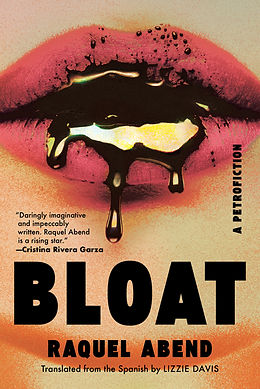
BLOAT: A Petrofiction (2/27)
Mercedita lives with her mother and grandmother, reeling from the recent death of her father and the intrusion of investigators into their home. Across the street is Merced, a sex worker entangled with an oil executive, soon to have a baby. Not far away, Mercedes – known to all as Mamé – runs La Tasca, a once thriving bar, now grave-quiet as the boom times come to an end. Mercy, who works at a restaurant frequented by the powerful, is sent home after coughing up blood.
These four Women are connected by the alternate Caracas they inhabit, by their female bodies, by their strength in the face of the fear and violence which shadows them – and by the oil around which the life of the city and country revolves, even as the fields dry up and the executives implement a new and unsettling system of production. In visceral and absorbing prose, Bloat explores exploitation, beauty and power, conjuring up a world that is not quite ours, but is hauntingly familiar.
Translated from the Spanish by Lizzie Davis
Praise for BLOAT: A Petrofiction
'Daringly imaginative and impeccably written. Raquel Abend employs narrative tools with the care of a poet, poses questions about the ways extractive, totalitarian regimes crush the human spirit, and commends how women build community despite all odds. Abend is a rising star.'
—Cristina Rivera Garza, Pulitzer Prize-winner, author of Liliana's Invincible Summer
'Imagine Octavia Butler’s Parable of the Sower with the plot attenuated and written in four parts that glance off one another but, like an exquisite corpse, still connect to form a larger, troubling image. Bloat is a delirious and compelling book about women trapped in an oil-soaked dystopia where, if you’re not struggling to make ends meet, you’re either a criminal or already dead.'
—Brian Evenson, author of Song for the Unraveling of the World
'Bloat is a hauntingly original novel with a dystopian premise that is all too plausible. It casts an unblinking eye on the ways oppressive societies consume their citizens, while exploring how life endures even under the bleakest circumstances. It will stay with me for a long time.'
—Daniel Loedel, author of Hades, Argentina
Books in Spanish
'- Did you think that if you died, you would have a second chance to live again?
- No... Obviously not - I answered.
- So, was it worth it?
These two questions underlie the meandering journey that is ANDOR, a journey that does not end with death but is born from it. The young Edgar, after a failed suicide attempt, finds himself in a limbo that is both disturbing and seductive: the Andor hotel, where he must stay until he decides if he really wants to die, come back to life, or stay there forever. ANDOR, then, asks itself - and asks us - how do we know if it was worth it. But it does so in the midst of drunkenness and hangovers, chatter and boredom, sudden infatuations and outbursts of jealousy, thus also exploring the most playful, the most visceral, and the simplest aspects of the fragile and contradictory human life. What are we condemned to when living it? What things will we always want to hold on to, no matter what the cost? With agility and sharp humor, Abend takes us through a shifting territory, full of wonder and threat, both fantastic and familiar, where – just like in what we call real life – everything can change in the blink of an eye.'
–Robin Myers, National Book Award in Translated Literature

Zofianka Kieślowski receives a letter that draws her back to Poland, fifty years after fleeing Jarosław as a young Jewish woman persecuted during the Second World War. Now a Catholic nun, she returns to reunite with her former lover, Henri Wozniak, whom she met in postwar Germany. Moving between Zofianka’s present and the story of her youth, Blue Room (Cuarto azul) is a novel about the hidden corners of memory and the risks of identity. With spare, incisive prose, Abend explores violence and the pain of loss, offering along the way an unforgettable protagonist.
'With this novel, Abend emerges as one of the most significant voices of a new generation of Venezuelan writers.'
–Miguel Gomes
'Each short story brings us closer to that moment of epiphany when someone radically changes course, makes irreversible decisions, or arrives at discoveries whose truth is both sinister and dazzling. Abend leads the reader to that broad, slippery edge from which to gaze into the abyss. Couples who live out their homosexuality in hotel rooms, translators who betray with calculated malice, and women who fall in love with adolescents. In the tradition of Chekhov, the economy of characters and settings is inversely proportional to their symbolic weight; Abend's stories work in much the same way, as highly precise artifacts in which melancholy takes hold with its fierce tenderness.'
–Giovanna Rivero

'Reflection on difficulty runs through the pages of On Factories by Raquel Abend: the difficulty of belonging, of inhabiting, of saying I. Faced with the small everyday catastrophes that open voids impossible to fill, faced with what is inert, dead, shattered, and broken, these poems pray with a cruel tongue.'
–Gina Saraceni
'In this poetry collection, we find an elegant and well-grounded feminism that coexists with other contemporary political concerns. Do you remember that woman who slapped you, but you didn't realize it until you felt an excruciating pain? That's Raquel.'
–Anjanette Delgado

'Raquel Abend transforms the autobiographical into an aesthetic experience of paradigmatically universal scope. She achieves this through poetry that is intense, incisive, unsparing, and at times relentless. The reader is left shaken: the poems constitute an explosive artistic substance. After encountering it, we are no longer—and cannot be—the same.'
–Armando Rojas Guardia
